Wednesday, March 9, 2011

Artist Jane Mayday


Hi Puzzlers,

Today I would like to share with you the biography of one of our artists, Jane Mayday. I just love her work, especially the cardinals. When I was young I took art lessons from Mr. Abbott, a local artist, and I would always paint cardinals. I’d paint them in oils and watercolors oh what fun that was!

Jane Mayday began her career at 14 years of age, as a scientific illustrator for the University of Florida. After receiving a Bachelors degree from Ringling College of Art and Design, she was recruited by Hallmark Cards Inc, as a greeting card illustrator. Though her scientific past helps Jane add realism to her artwork, she soon discovered she enjoys painting the outsides of animals to the insides!

Jane left the corporate world after her children were born and moved to beautiful Colorado. Her work has adorned 25 children’s books, as well as collector’s plates, ornaments, cards, t-shirts, garden flags, jigsaw puzzles, and much more.

Recently Jane added author to her list of accomplishments, writing the best-selling art instruction book, “Adorable Animals You Can Paint” (published by F&W Publications), as well as numerous smaller works and magazine articles. Her newest F&W books are Cute Country Animals You Can Paint, and Landscapes in Bloom.

In addition to the breathtaking Colorado Landscape, Jane has two children, a menagerie of animals, and a garden for inspiration, and a wonderful husband to share it all.

Happy Puzzling!

Wednesday, March 2, 2011

King Kramer


Hi Puzzlers,

Today, I, King Kramer, have decided to write the blog and share my thoughts on what it's like to run a puzzle company. Let me tell you-it is a lot of work and there are many things to oversee. There is wholesale, retail, office management, shipping and receiving, research and development. Ah! The list seems to be endless.

My morning begins promptly at 7:50 AM; this is when my ladies/servants arrive. The first one in has the pleasure of preparing her coffee and my breakfast,Kibbies. This is a special breakfast from my homeland, Bleski which is just north of Poland. While I wait, I go over the wholesale orders that have come in. Patsy and Melinda do such a great job I will have to remember to give them a treat.

Next it is off to the retail department. Alicia is going through all the mail while Jill, Cathy, Kathy and Jean are busy answering phone calls from all our puzzlers. I have such wonderful hard-working staff. Oh, what was that! A mouse! Don’t fear ladies, I, King Kramer will protect you! Oh wait, it was only Princess Toasty, my sister. She thinks it’s funny to act like a mouse and scare my ladies. If she weren’t related I would have her banished. But that’s just between us.

Bruce, Matt and Lori all work at the warehouse in Conway. Sometimes even I am amazed to see how many puzzles they ship. And if you want to see a clean warehouse, this is the place to go. Unfortunately, since my crate broke down I have not been able to visit. You all know how hard it is to find a good mechanic.

Now I’m off to the head office where I keep Kim, the office manager and bookkeeper. We go over several reports and I get a chance to look over some payables and receivables. I must confess the numbers thing is not my strong suit but thankfully Kim keeps thing going nicely.

WOW! It is already 4:30 PM. I will have to send my ladies home. Ah, they are so good to me; they made me dinner before they left. It is good to be the king!

Oh! This is my newest puzzle. Do you like it?


Happy Puzzling!

Wednesday, February 23, 2011

Batters Up


Hi Puzzlers,

Sports fans across the nation have begun to rejoice- it's spring training time! So today I would like to tell you about a fact from our country's national pastime that seems to be fading from memory, the All-American Girls Professional Baseball League.

During World War II major league baseball players were not drafted, but many of the young men who played on the minor leagues were. As a result most minor league teams disbanded. This disbandment left a huge gap in revenues generated by the Major League Baseball parks. Fear of collapse spurred Chicago Cub owner Philip K Wrigley to form a committee to search for possible solutions. The committee thus recommended using the girl’s softball league and so in 1943 the All-American Girls Professional Base-Ball League was born.

The first issue the committee needed to decide on was which game would be played. Women’s semi-pro softball teams at the time used a 12-inch softball and under handed pitching and teams consisted of ten players. In an effort to incorporate the two games the distance between bases were increased and men’s base running rules were incorporated; this allowed for the stealing of bases - and we all know how fun it is to watch for a stolen base! The team’s size was also reduced to 9 players.

Next, talent scouts scoured the country and Canada looking for players. Try-outs were held in all major cities and hundreds of women showed up looking for their chance to play for this new professional league. Sixty lucky women were chosen.

The women that were chosen had strict contracts forbidding any other type of employment during the season. Salaries ranged from $45 -$85 a week, which was higher than most of their professional parents. Strict moral codes of conduct would also have to be adhered to. Femininity was crucial. The girls received training on hygiene, etiquette, and dress codes. Charm school training also taught the girls how to act in every situation. “Physical attractiveness was a must and players received beauty kits and instructions on how to use them.” The All-American Girl Next Door, along with outstanding athletic ability was a top priority.”

The League's popularity peaked in 1948, selling 910,000 tickets to paying fans. By 1950, the league became decentralized and televised major league game saw to the demise of the All-American Girls Professional Baseball League, but not before giving over 600 women the chance to play baseball at a level never before obtained.

Happy Puzzling!

Wednesday, February 16, 2011

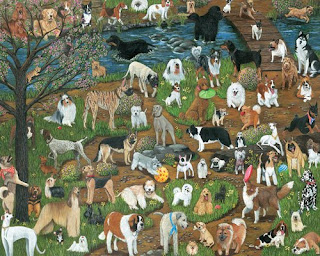
Who Let The Dogs Out


Hi Puzzlers,

Last night's Westminster Dog show was amazing! I can’t believe the dog that won. Hickory, a 5-year-old Scottish deerhound, was named "Best in Show." I hadn’t even heard of a Scottish deerhound. I am familiar with several breeds including my very own Tibetan terror-Oops- I meant Tibetan terrier, Mario, but a Scottish deerhound? Nope-never heard of them. This got me thinking how and where did all the breeds come from?

Dogs, as many of you may already know, are said to come from wolves. It is believed that orphaned wolf pups taken at an early age could be tamed and socialized. These orphan pups were also, thought to have been nursed alongside human babies. Along with the tamed qualities, wild wolves that were the most social and least fearful (of humans) were bred together and overtime they would become more dog-like. It is also believed that dogs were used as beast of burdens, long before the horse and ox, and as a source of meat! WOW! Eat my dog? No way!

Over time the domestication of the wolves produced several physical changes including the reduction in overall size, smaller teeth and cranial cavities. The reduction in brain size affected the areas no longer needed by the domesticated wolves, such as alertness and the regurgitation of partially digested food to feed the pups.

As humans moved towards agricultural societies, desirable dog traits would also change. Now there are seven classifications used by the AKC. 1) The Sporting Group- bred to aid hunters by finding, flushing out and retrieving game. 2) Working Group-“bred to perform such jobs as guarding property, pulling sleds and performing water rescues.” 3) Toy Group- companion dogs. 4) Terrier Group- bred to hunt small animals. 5) Hound Group- bred to follow game by sight or smell. 6) Herding Group- bred to herd and control cattle and sheep. 7) Non-Sporting Group- breeds that don’t fit into these other groups. My Mario fits here.


Happy Puzzling!

Wednesday, February 9, 2011

Victory Garden


Hi Puzzlers,

The buzz here at the office has been all about getting ready for spring and picking out garden seeds. Well I don’t have a garden but I’ve been thinking about planting a small raised one, so I pulled out our Victory Garden puzzle and started looking at all the different seed packets to find inspiration. WOW! I really did find some inspiration.

I found out that the term Victory Garden was an actual term used to describe home gardens that were planted during both World Wars. These gardens were planted in backyards, empty lots, rooftops, and public parks and on community land. All this was done in the name of patriotism.

As a part of the war effort Allies across the world had put rations on foods like sugar, eggs, coffee, milk, cheese, meat and canned goods. Citizens were urged to produce their own “war garden” in an effort to reduce the pressure on the public food supply. First Lady Eleanor Roosevelt even planted a “food garden for defense” on the White House lawn. Nearly 20 million Victory Gardens were planted yielding an estimated 9-10 million tons of fresh fruits and vegetables. This amount was equal to “all of the commercially produced fresh vegetables, so the program made a difference.”

Citizen were also encouraged to can their own fruits and vegetables so the commercially made items could be sent to the troops. In 1943, 315,000 pressure cookers were sold versus the 66,000 sold in 1942. Popular women’s magazines began including gardening and canning articles.

One of the oldest remaining Victory Gardens is the Fenway Victory Garden in the Back Bay Fens of Boston, Massachusetts. The gardens are located on 7 acres of the Fens. Presiding over the 500 plots, each 15 feet by 25 feet, is the famous Prudential building. “The gardens are named for Richard D. Parker, a member of the original garden organizing committee. Thanks to his efforts the gardens are now an official Boston Historic Landmark.”

In 2009 First Lady Michelle Obama planted a vegetable garden on the South Lawn of the White House. This is the first garden to be planted at the White House since Eleanor Roosevelt’s victory garden. The First Lady planted the garden to help “educate children about healthful, locally grown fruit and vegetables at a time when obesity and diabetes have become a national concern.”

Happy Puzzling!

Wednesday, February 2, 2011

Hen Pecked


Hi Puzzlers,

Check out our newest puzzle Hen Pecked by artist Rollie Brandt. I just love it! It reminds me of my trips to Cape Cod. “Cape Cod and chickens?” I know, it sounds strange, but when we go to the Cape the first thing we do is go to my sister-in-law’s and pick up a dozen of what we call rainbow eggs. Sheri raises the chickens in her back yard, with the help of the family dogs, Ruby and Riley. These eggs are delicious and the different colors are just fun. Once we have the eggs picked everyone claims his or her eggs by color. I like the green ones; it’s like the Dr. Seuss book Green Eggs and Ham. Yes, its fun not to have to completely grow-up!

Sheri says the eggs are different colors due to the breed of the hen. She likes the rainbow effect and therefore raises several different types of hens. She also claims that free-range eggs taste better than any egg you’ll buy at the store. And I would have to agree. It did take me a while to get past the strange new colors of the shell. Growing up I had only seen white or brown eggs in the grocery stores. Also, the egg itself looked different. The yolk was a deep golden color and the white was not even a little runny. But, oh my yummy-ness they taste GREAT!!!

“The chicken (Gallus gallus domesticus) is a domesticated fowl, a subspecies of the Red Jungle fowl. As one of the most common and widespread domestic animals, and with a population of more than 24 billion in 2003, there are more chickens in the world than any other species of bird. Humans keep chickens primarily as a source of food, consuming both their meat and their eggs.” Recent evidence indicates chickens have been domesticated for over 10,000 years.

Chickens are omnivores and may live for five to ten years depending on the breed. Hens of special laying breeds can produce as many as 300 eggs per year. The world’s oldest chicken died at 16 of heart failure. Domestic chickens aren’t able to fly long distances, though; they can fly short distances to explore their surroundings or to roost on a tree or fence.

Chickens live happily in flocks. They establish pecking orders as new hens are added or as roosters are removed. This disruption can lead to violence and injury but once the order is established the flock returns to a harmonious state. The more dominant hens will have priority on food and nesting areas. Hens like to lay eggs in nests that already have eggs in them. Some hens have been known to move eggs from another hens’ nest to their own. An old trick used by farmers is to put fake eggs or golf balls in a nest to encourage the hen to lay eggs in a particular nest.

Now on to the Easter Bunny’s best kept secret. The Araucana and Ameraucana, also known as “Easter Egg Chickens”, are the two breeds of chickens that are known for laying colored eggs. Sorry Sheri, AKA Bunny, your secret is out!


Happy Puzzling!

Wednesday, January 26, 2011

Kites


Hi Puzzlers,

Just the other day I was driving by the park and notice a couple of kids flying kites. The brightly colored kites against the blue sky and the children bundled up like little snow-babies running through the snow was a beautiful site. I have seen children flying kites many times in the summer months but never in the winter.

Historians estimate that kites have been flying in our sky for at least 2000 years and many believe kites originated in China and the South Seas. “One legend suggests the first kite was made when a Chinese farmer tied a string to his hat to keep it from blowing away in a strong wind.” Kite flying was most likely invented for fun, but has had many uses thoughtout the years.

Militaries throughout the globe have used kites for target practice, and as bombs by attaching explosives to the kite and sending it over enemy lines, or by igniting it and crashing it into an enemy ship. Kites were used as a form of airmail between Maryland and Virginia during the American Civil War and during WWI kites were used for enemy observation and signaling. Kites in “WW II were provided with life rafts and intended for use in raising emergency antennas when sailors needed to abandon their ships.”

The scientific community has used kites for wind and weather research and to raise meteorological instruments and cameras into the skies. Most famous is Ben Franklin's use of a kite to prove that lightning was an electric phenomenon.

Kites were also used for measuring distances when it was difficult or dangerous to physically walk to another location. A rope would be attached to the kite and it was then flown over to the other side. This technique was used in the building of the bridge across Niagara Falls (New York to Canada) and to carry telephone wires.

One of the most unusual uses of kite power came from George Pocock in 1822. George used a pair of kites to pull a carriage; this use saved him on taxes as road taxes at the time were based on the number of horses a carriage used. Some of his trips would record speeds between 20 and 100 miles per hour!

Today’s kite uses include kite sailing, kite surfing, kite skiing and kite buggying.

Happy Puzzling!

Wednesday, January 19, 2011

Circus Thrills


Hi Puzzlers,

Wouldn’t you agree that our Circus Thrills puzzle by Mary Thompson captures a great piece of American history? How many of you remember your first time at the circus? Just hearing the circus was coming to town could get one filled with excitement and wonder. I even imagined a few times I would sneak away and become a circus performer and travel the country too. For many, the circus was the only opportunity to see live exotic animals, and performers.

The first circus to come to the United States was brought in by an Englishman named John Bill Ricketts. On April 3, 1793 Ricketts opened the first circus building in Philadelphia. It was such a hit that by season’s end George Washington himself attended a show. Unfortunately the amphitheater burned to the ground in 1799 and Ricketts would die the following year, but not before America had caught circus fever.

At that time (1799-1865) the circus consisted of basically three different types of acts first the menagerie, with exotic animals on display; second, troupes of diverse acts, including juggling, acrobatics and riding; and third, the combined acrobatic show and menagerie. All three were popular, but it was combination circus and menageries that would eventually become the standard for the traveling circus. In 1833 Isaac A .Van Amburgh (considered to be the first animal trainer) entered a lion’s cage and stuck his arm and head inside the mouth of the large cat, thus ushering in a new era in menageries and audience excitement.

In 1841 P.T. Barnum opened Barnum’s American Museum, which was a far cry from the typical museum. Barnum had on display “Chinese jugglers, serpent charmers, glassblowers, ventriloquists, performing fleas, Native American chiefs performing war dances, trained chickens and dogs, an orangutan, a knitting machine and a scale model of Paris.” But his display of hoaxes, including the Fejee Mermaid, the Cardiff Giant mannequin and the introduction of the smallest man in the world, General Tom Thumb, would have people talking and wondering for years.

Unfortunately the traditional circus is becoming a thing of the past so hurry and bring your young loved ones to a circus or show near you.

Happy Puzzling!

Wednesday, January 12, 2011

Route 66


Hi Puzzlers

Every time I see our Route 66 puzzle I get filled with curiosity. I try to envision what it would have been like traveling that highway in the 1930’s and then again in the 1950’s. Would I fear for my life or be getting my kicks?

Between 1916 and 1921, Cyrus Avery of Tulsa, Oklahoma and John Woodruff of Springfield, Missouri are said to have been instrumental in promoting the idea of a highway which would link Chicago and Los Angeles. Once their lobbying efforts were combined with the 1925 government expanded legislation for public highway construction, Route 66 would soon be underway. The official number 66 was assigned to the route in 1926.

Approximately 210,000 people migrated to California to escape the despair caused by the Dust Bowl of the 30s, which by 1934 had affected an estimated 100 million acres of farmland, thus Route 66 quickly became known as the “road to opportunity.” In the early years it was common to travel Route 66 in caravans which provided protection and assistance. During the depression years thousands of unemployed men from every state worked as laborers on road gangs to complete the final miles of highway.

“Completion of this all-weather capability on the eve of World War II was particularly significant to the nation's war effort. The experience of a young Army captain, Dwight D. Eisenhower, who found his command bogged down in spring mud near Ft. Riley, Kansas, while on a coast-to-coast maneuver, left an indelible impression. The War Department needed improved highways for rapid mobilization during wartime and to promote national defense during peacetime. At the outset of American involvement in World War II, the War Department singled out the West as ideal for military training bases in part because of its geographic isolation and especially because it offered consistently dry weather for air and field maneuvers.”

After the war many of the service men from the east coast chose to relocate to the warmer climates of the west and southwest with Route 66 facilitating their journey. Route 66 meant people no longer had to stay local and the west was an adventure waiting to happen. As a result gas stations, hotels, motels, restaurants, souvenir shops and entertainment spots sprang up along the highway offering tourists and weary travelers a place to rest and relax.

“As a result some of these small businesses developed into corporations, building franchised locations in state after state. Soon travelers deserted the small eateries, gas stations, and tourist camps located in the center of towns for the familiarity of heavily-advertised McDonalds, Whiting Brothers, and Howard Johnson.”

By 1970 most of Route 66 had been by-passed with four lane highways and it was officially removed from the US Highway System on June 27, 1985. Recently Historic Route 66 has begun to return to maps and the actual signs include historic information.

Happy Puzzling!

Wednesday, January 5, 2011

Winter Birds


Hi Puzzlers,

Yesterday while sipping my morning cup of coffee, gazing, bleary eyed, out the window I noticed a couple of blue jays searching the ground for food. It got me thinking that it would be nice to have a bird feeder or two of my own so I could watch birds every morning! Ah, it’s little pleasures like this that make life grand. Then panic set in as I thought about making them dependent on me for food and what if I forgot to feed them!

Well, it turns out that birds find 80 percent of their food on their own and 20 percent from bird feeders, which increases their odds of surviving the winter. Some birds even store food. Crows, nuthatch, chickadee and jays, to name a few, have memorized where they store food (tree bark or under leaves…) and can even find it 6 months later. Birds also follow a daily route to gather food, so, if your feeder happens to be empty don’t worry, he will eat at the next feeder. But be sure to fill your feeder as soon as possible to ensure the birds keep your feeder on the route.

If you are looking to attract different species you will need to have different types of food in feeders hung at different levels. Black oil sunflower seeds attract several different types of birds including cardinals, woodpeckers, blue jays, goldfinches and chickadees. The goldfinch love Nyger even more than thistle, though it tends to be more expensive. Are you sick of squirrels and blue jays eating your sunflower seeds and scaring the other birds? Then try the smaller white safflower seeds.

Another must-have is suet. Suet is made of animal fat and other “yummy” bird treats that attract insect eating birds. Unlike us birds use massive amounts of energy (up to 10,000 calories a day) and any extra fat in their diet is good. Another great thing to keep in mind is that the birds that feed on Suet love to feed on the bugs found in your summer gardens. Don’t you just love a natural pesticide?

Also, please remember to provide fresh water for your visiting birds (unfrozen water is hard to find in the winter months) and to clean your bird feeder occasionally with a 10 percent solution of bleach. This will help reduce the spread of disease.

Happy Puzzling!

Wednesday, December 29, 2010

Chinese New Year


Hi Puzzlers,

Here in the western hemisphere New Years Day is celebrated each year on the first day of January, but in the East, the Chinese New Year can happen any time between late January and mid-February. This happens because the Chinese calendar is based on tracking the ever-changing new moon, which results in this year Chinese New Year falling on February 3, 2011. It is the Year of the Rabbit. This eastern-based holiday is the equivalent of mixing our western Thanksgiving, Christmas and New Years Day into one massive 15-day celebration.

Just like us, preparation for the holiday starts about a month in advance as people start buying presents, food and decorations. Ten days before the New Year's Day celebration the “Sweeping of the Grounds” or the annual housecleaning begins. Tradition states that every corner of the house must be swept and cleaned as a way to remove bad luck and negative energies.

Also very similar to western celebrations are the wearing of the color red and fire work displays. “One of the most famous legends is Nian, an extremely cruel and ferocious beast that the ancients believed would devour people on New Year's Eve. To keep Nian away, red-paper couplets are pasted on doors, torches are lit, and firecrackers are set off throughout the night, because Nian is said to fear the color red, the light of fire, and loud noises.”

“The lunar calendar has a sixty-year cycle. In the Chinese horoscope, the five basic elements of Metal, Water, Wood, Fire and Earth, which make up all matter, are combined with the twelve animal signs of Rat, Ox, Tiger, Rabbit, Dragon, Snake, Horse, Lamb, Monkey, Rooster, Dog and Pig to form the sixty year cycle. One's Chinese horoscope is based on which lunar year in this sixty-year cycle one was born.”

2011 is the year of the metal-rabbit. A rabbit year is a calming year, a year that allows one nerves to be soothed, to catch your breath and relax. We all need it after the tough tiger year of 2010.

Happy New Year!

Wednesday, December 22, 2010

Winter Solstice


Hi Puzzlers,

Today is one of my husband’s favorite days, the first day of winter or Winter Solstice. He loves this day because summer begins tomorrow with the days getting longer and longer. The Winter Solstice marks the shortest day and the longest night of the year. While researching this topic I found the Earth is actually closer to the sun in January than it is in June by three million miles! But, because of the way the earth tilts and depending on your hemisphere, those leaning farthest away from the sun get the Winter Solstice.

Even more amazing is the fact that ancient people who studied the stars and heavens (without all the sophisticated equipment we use today) could predict with complete accuracy when these changes would occur. They knew when the Winter Solstice would arrive and they knew the sunlight hours would slowly increase thereafter. WOW! That is surely a testament to the skills of observation. If you need proof check out Stonehenge in England or Newgrange Megalithic Passage Tomb in Ireland. “But not so many people are familiar with Newgrange, a beautiful megalithic site in Ireland. This huge circular stone structure is estimated to be 5,000 years old, older by centuries than Stonehenge, older than the Egyptian pyramids! It was built to receive a shaft of sunlight deep into its central chamber at dawn on winter solstice.”

“The winter solstice may have been immensely important because communities were not certain of living through the winter, and had to be prepared during the previous nine months. Starvation was common in winter between January and April, also known as the famine months. In temperate climates, the midwinter festival was the last feast celebration, before deep winter began. Most cattle were slaughtered so they would not have to be fed during the winter, so it was almost the only time of year when a supply of fresh meat was available. The majority of wine and beer made during the year was finally fermented and ready for drinking at this time.”

Worldwide, interpretations of the winter solstice vary from culture to culture, but for most cultures it’s about the acceptance of rebirth. The rebirth concept is usually celebrated with holidays, festivals, gatherings, rituals or other celebrations around this time of year.

Happy Holidays!


Wednesday, December 15, 2010

The Twelve Days of Christmas


Hi Puzzlers,

I just learned that the cute holiday song, "The Twelve Days of Christmas", has three different stories behind why it was written. Gosh, even something that seems so simple can be complicated. I guess there is always a story behind the story, or in this case, stories.

Historical sources dating back 150 years all classify “The Twelve Days of Christmas” as a counting song for kids. In the 1842 edition of The Nursery Rhymes of England, author J.O. Halliwell details how the rhyme was used as a game. “Each child in succession repeats the gifts of the day, and forfeits for each mistake.” Well you know what they say, whoever "they" are, “Repetition is the mother of skill.”

Next, and the strangest to me, is that "The Twelve Days of Christmas" is a love song. University of Massachusetts classics professor Edward Phinney said in a 1990 newspaper interview, “If you think of all the things being presented, you realize they’re all gifts from a lover to a woman. Some of them are rather impossible to give, like eight maids milking, and nine ladies dancing and pipers and drums all imply this is a wedding.” I guess that makes sense, so going forward "The Twelve Days of Christmas" song will now be played at all holiday weddings!

Last on the list is that "The Twelve Days Of Christmas" was written “to be a catechism song for young children.” This tale states that back in the sixteenth century Roman Catholics in England were not allowed to practice their faith and would be persecuted, children and all, if they were caught. So this carol was written with hidden meaning and symbolism to teach young Catholics about the doctrine. Ace Collins describes the hidden meaning in his book, Stories Behind the Best Loved Songs of Christmas.

WOW! All those stories for one cute Christmas carol.

Happy Puzzling!

Wednesday, December 8, 2010

Politics


Hi Puzzlers,

Have you seen our newest puzzle “Politics”, yet? Artist James Mellett did a great job capturing the theme. The political arena has certainly changed through the years and it makes me wonder what the founding fathers would think.

The Declaration of Independence states, “of the people, by the people and for the people.” With just a quick glance at the puzzle you can see this to be true as it is filled with people of differing backgrounds and ethnic origins. It’s all here, from peanut farmers to astronauts. Do you remember what presidential candidate said, “I'm mad as hell and I'm not going to take it anymore.”(Taken from the movie Network). Do you recognize some American actors turn politician? Here a few hints, “I got you babe”, “Go ahead make my day” and “I’ll be back.”

The declaration also states, “that all men are created equal.” So, I’m not sure what the founding fathers would think of the rising number of women and ethnic minorities in politics. In particular, women trail blazers like Bella Abzug, Hillary Clinton and the unforgettable Sarah Palin whose has been portrayed by comedian Tina Fey with the infamous quote, “ I can see Russia from my house”.

How would they respond to an African-American man as president with his family living in the White House and Colin Powell as Commander in Chief, or the likes of civil and political activists such as Jesse Jackson, Martin Luther King Jr. and Rosa Parks?

Also tied to politics are the scandals. Will we ever forget hanging chads, Oliver North, Monica Lewinsky and Watergate? These scandals make for entertaining political television and radio with hosts such as Bill O’Reilly, John Stewart, Keith Oberman, Stephen Colbert and the infamous Rush Limbaugh.

Happy Puzzling!

Wednesday, December 1, 2010

Finding The Perfect Tree


Hi Puzzlers,

I just love the holiday season steeped in tradition. Finding the perfect tree has become a tradition for my family and I don't think it would feel like Christmas if we didn't do it.

Our tree search always begins at the Rocks Estate Tree Farm, on the coldest day of the year. Once at the farm we head to the furthest point, down by the wall, to find the Frazier Fir we love. We spread out looking for that perfect tree. Once we each find a tree, we all have to decide which is the best of the best. After several heated moments of debate and walk- a- rounds of each other’s tree, a decision is made.

With trusted saw in hand we begin the cutting down process. (Tip from prior years cutting: hold tree at the top and middle so it doesn’t land on your husband). After several passes of the saw the tree is down! Hurrah! Next we drag the tree to the waiting wagon a half a mile away. OMG’s can be heard as we can’t believe how big the tree is now that is down. “It didn’t look this big next to the other trees… I hope it fits through the door… What else can we do with the extra tree limbs? Sell wreaths? I think to myself.”

“WOW”! This tree weighs a ton shouts my husband, as my daughter is sitting on the back of the tree. Finally we reach the crest of the hill, sweat pouring off of us like a fountain, jackets opened flapping in the breeze, hair standing straight up from getting wet under our hats, something brown and squishy coming from under your boot, and meet the wagon. The attendant gives us a ticket and wraps one around the tip of our tree.

Exhausted we make our way back to the lodge for some homemade treats and local New Hampshire craft shopping while we wait for the tree attendant to wrap our tree for the ride home.

Now rested and refreshed we make our way to the wrapped trees. The attendant greets us and asks for our ticket. You have it. No, I gave it to you! Check your pockets!!! After five minutes of this we finally find the ticket and get our tree.

Back at the car with wrapped tree in hand we fold down the backseat so we can stuff the tree in through the trunk (Who needs a truck). Once the treetop reaches the front wind shield we know we are going to need the bright red flag you attach to things when they hang out of the trunk more than two feet.

Within a half hour we are ready to go and it only took twenty feet of rope! With our hands and boots covered in sap and squishy brown stuff, we head off on our one-hour trip home.

Ah! I just love a tradition.

Happy Puzzling!

Wednesday, November 24, 2010

Internet Shopping Safety Tips


Hi Puzzlers,

Yes it’s that time of year again, Holiday Shopping Time that is! I started my online list last week and while ordering what I thought was the best priced dog bed I got a funny feeling about the website. This site looks strange, I thought. Then I remembered some of the tips we talked about last year on our “Internet Shopping Safety Tips” post, I immediately looked for the tiny closed padlock and the "s" after the http, and both were missing. Then I looked into the company and found several customer complaints and bad reviews. Needless to say, I did not place the order with them. We want to keep our puzzlers safe so here are the online shopping safety tips with a few updates.

Trust your instincts - If you have a funny feeling about the site check it out before placing the order. If an offer sounds too good to be true, it probably is a scam.

Protect your PC - Make sure your personal computer has recent updates installed for Spam filters, anti-virus and anti-spy software, and a secure firewall.

Trusted Websites - Shoppers should know whom they are dealing with. Confirm the online seller’s physical address and phone number. Anyone can set up an online store under any name. Do not respond to the pop-up asking for personal or financial information. Real companies would not ask for this type of information via emails and pop-ups (phising). Check for security seals, such as the tiny padlock icon and the http (URL) has an “s” in it. The https:// stands for secure.

Keep your Web browser updated - “Internet Explorer 7 and 8 provide another layer of protection with Web sites that use Extended Validation (EV) Secure Sockets Layer (SSL) Certificates. The address bar turns green and has both https and the closed padlock. An EV SSL certificate not only helps ensure that communication with a Web site is secure, but it also includes information about the legitimacy of the Web site, which has been confirmed by the Certification Authority (CA) issuing the SSL Certificate.”

Don’t shop using Wi-Fi - When using Wi-Fi at a coffee shop, hotel, airport, or restaurant, you are making yourself vulnerable to identity theft. Your iPhone, Blackberry, Smartphone and laptop can easily be hacked on a free or paid public Wi-Fi spot.

Pay by credit or charge card - By using a credit or charge card you are protected by the Fair Credit Billing Act. This law gives you the right to dispute charges and temporarily withhold payment while the credit card company investigates your claims. Never use your debit card, as you have no rights protecting you from fraud or theft. Try to use just one credit card for all your purchases; this will make it easier to spot fraudulent charges.

Insure the safe delivery of your item -
If you’re concerned about the safety of your package if there’s no one home to receive it, request it be sent with a signature required. Or, it may be safer to have the package delivered to your office.

Refund Policies and Delivery Dates -Make sure you know if you can return the item for a full refund and who pays the shipping for the return. Is the refund for a store credit or cash refund? Know when you should expect delivery of your item.

Print & Save - Keep documentation of your order. If confirmation was sent by email, keep the email and save any and all correspondence with the retailer.

Happy Puzzling!

Thursday, November 18, 2010

Ice Cream


Hi Puzzlers,

Don’t you just love our newest puzzle Ice Cream Candy Swirls? Ice cream has always been my favorite treat. Notice I didn’t say dessert, because I eat it morning, noon and night, for any and every reason. People have been enjoying this scrumptious treat for centuries.

Prior to 1553 most frozen treats were more like today’s slushies or snow cones. Around 400 BC the Persians developed a dessert of frozen batter and rose water flavored with fruit and saffron, while Alexander the Great enjoyed mixing snow with fruit and honey. Roman Emperor Nero (AD 54-86) sent his servants to gather snow and ice so it could be served with fruit and juices.

Legend states it was Catherine de Medici, upon marrying King Henry II of France, who brought the ice cream from Italy to France. The recipe called for the use of cream rather than milk and this is why Italians are credited with being the first to invent ice cream. My Italian husband started dancing around like a crazy mad man when he found this out and the smile is yet to leave his face.

In America most everyone loves their pie a la mode. But be careful with the term in a European country! "In French cuisine, a la mode (literally 'in the fashion') refers to a dish of beef braised with vegetables and served either hot in a rich brown sauce or cold in aspic. In the USA, however, a la mode denotes a dish (such as apple pie) served with ice cream." The American a al mode phrase (served with ice cream) became popular in the late 1890’s.

When doing this puzzle please enjoy a dish of your favorite ice cream for added pleasure.

Happy Puzzling!

Wednesday, November 10, 2010

Team Building With Jigsaw Puzzles


Hi Puzzlers,

Today Jill was speaking with one of you and was told that our puzzles were going to be used as a team building exercise. WOW, we thought-what a great idea. It turns out that jigsaw puzzles are being used world wide as a team building option.

Puzzling is a low cost, easy to use item that is fun to do. No hanging off a tree line 600 feet in the air required for this team building exercise! It can be done in the comfort of any building with enough space for tables to build the puzzles on and the weather will not ruin this planned event. You can team build with small groups or large, and the possibilities for tweaking the exercises are only limited by your imagination.

Here is how our puzzler planned to use the puzzles for her team building exercise in a business environment for about 80 customer service reps. “We cut up the colored photo of what the puzzle looks like, and then there is a trivia game that teams have to answer (kind of like Family Feud). Whoever answers the questions correctly wins a piece of what the puzzle actually looks like. There are several teams going against each other so not everyone gets a lot of pieces of the picture Then, the team has to work together to put the puzzle together with what they have. It's hard to put a puzzle together without knowing what it looks like.” This sounds like a ton of fun to me!

A good team building exercise will usually require team members to communicate, help each other, negotiate, work together to solve a problem, trust each other and discover how much the team members need each other. You’ll also want to give the team building exercise a long lasting effect by taking plenty of pictures and posting them where everyone can see them. You may even want to give the winning team a custom made puzzle of the team with an inspirational saying, such as, TEAM, Together Everyone Achieves More.

Happy Puzzling!

Wednesday, November 3, 2010

Election Day


Hi Puzzlers,

Yesterday was Election Day and I am happy to report I did my civic duty and cast my vote. I am one of those people who always drag their kids with them so they can see the election process first hand. On the drive over my daughter started asking all kinds of questions regarding Election Day. Why is it always held in November on a Tuesday? When did women get to vote? Why do I have to be 18 to vote? (Oh no, having a flash back from the “Need to Know Everything” post). So began my search for the answers and here is what I found.

November was the perfect month for young America. During this time American society was mostly agrarian, which meant that by November farmers would have already finished up with the fall harvest and November was early enough to avoid any major winter storms.

Tuesday was chosen because people traveled long distances by horse and buggy to get to the polls. Sunday could not be used as a travel day because it would interfere with church services. The first day of the month could not be used as most businesses did their end of the month work on the first of each month. Also, November 1st is All Saints Day, a Roman Catholic holy day of obligation and Wednesday was when most towns had their farmers’ market.

“In colonial times, New Jersey permitted women to vote but that right was subsequently taken away. In 1869 Wyoming gave women the right to vote. By 1914, all states west of the Rockies, except New Mexico, had adopted full suffrage. Finally in 1920, the 19th Amendment gave all women the right to vote.”

The legal voting age was changed from 21 to 18 in 1971. Young people at this time were being drafted into the Vietnam War and campaigned rigorously to change it: “old enough to fight, old enough to vote.”

WOW! America definitely has some great history!

Happy Puzzling!

Wednesday, October 27, 2010

Meet Artist Suzy Toronto


Hi Puzzler,

Today we would like you to meet artist, Suzy Toronto. We have been receiving lots of kudos from puzzlers about how much you love Suzy’s work. I even heard from one of our puzzlers who said she had planned a girls-night puzzle-party around the Wonderful Wacky Woman puzzle! I wish I lived closer, I’d be crashing that party. Good friends, food, wine and a puzzle…. Ah, life is good.

This picture is of Suzy and Ted at a show in Atlanta. Suzy said, “When I'm not at an art show or sitting on the beach, this is where you'll find me -- working on a new idea or project that kept me awake the night before. The bottom line is I love to create. Whether I'm painting fine art in my studio, drawing my wacky characters on location at shows, sitting at my pottery wheel on my back porch, or writing at my computer, the creative process is liberating beyond words. I am forever exploring new ways to express the energy inside me. But I feel forever blessed to have these gifts and vow to never take them for granted.

I'm 47 years old, live in Tangerine, Florida in a house surrounded by 100 year-old oak trees. I share that space with my husband, Al, and my 28-pound cat, "Bob." I eat chocolate truffles while I paint -- and when they run out, I quit. I drink Perrier sparkling water so much I'm considering taking out stock in the company. I practice Yoga, which for some strange reason I think will help compensate for my horrible diet, and I go to the beach every chance I get.
I have five grown children and ten grandkids who love me as much as I adore them. I've taught them to dip their French-fries in their chocolate shake, make up any words they want to any tune they like and to never, ever color inside the lines. (However, they all feel the need to assure their friends that they also have another set of grandparents who are 'normal').”

Thanks, Suzy, for tapping into the souls of all Wonderful Wacky Woman!

Happy Puzzling!