Wednesday, June 15, 2011

Sun Protection


Hi Puzzlers,

Summer officially begins June 21st and this is the time of year when most of us start thinking about sunscreen and sun-protection in general. I’m kind of a crazy person when it comes to blocking the harmful effects of the sun. I do all I can to prevent burning and over exposure which leads to skin cancer. But every year I get more perplexed by all the choices in protection and which SPF’s are actually the best. Should I pay more for the 100 SPF and is it really that much better than 30SPF or 50SPF? Does a brand name guarantee a better product? Here is a quick look at what I found.

The best SPF choice for protection is the 15SPF to 30SPF range. Higher SPFs (Sun Protection Factor) only add 1%-2% more protection. Choose the higher SPFs if you are not diligent about re-application and also the 30SPF if you will be vacationing in an area with higher a UV indexes such as the Caribbean. Also, there’s not much difference between adult sunscreen and child or baby sunscreen. Don’t forget your lips - they burn too! Use SPF15 and above.

Buy products that state they are a “Broad Spectrum” protectorant or UVA/UVB protectorant. UVAs give you wrinkles and skin cancer and too much UVB exposure results in sunburns and skin cancers. Be sure to read the ingredients and look for avobenzone (this one can be irritating), titanium dioxide, or zinc oxide as one of their ingredients as these products insure UVA protection. Unfortunately, some sunscreens say they are Broad Spectrum but really aren’t. Also, if your skin is sensitive look for PABA free.

Waterproof or Water Resistant: Go with the waterproof as it provides 80 minutes of water protection versus the 40 minutes of protection from the water resistant. Plus waterproof provides better protection from sweating. It is best to always go with a waterproof even if you’re not planning on getting wet or swimming.

Brand name verse store brand: Consumer Reports says expensive isn’t always better and reports that some store brands that were the least expensive rated in the good to very good range!!!

Apply sunscreen properly…unfortunately most of us don’t!

Apply sunscreen 15-30 minutes before going out. It needs this long to be absorbed by the skin. Also apply enough! No skimping here; Adults need at least 1 ounce.

Apply sunscreen to all exposed areas and don’t forget your back, neck, ears, face, hands and feet. Use it rain or shine. You can be burned in cloudy weather.

Reapply sunscreen every two hours, it does not last all day. Reapply it after you come out of the water-YES! Every time.

Sunscreen and bug repellent: The sunscreen must be applied first and you should give it time to be absorbed (fifteen minutes), then apply the bug repellent.

Wear UPF Clothing: This is different than SPF as it rates how much the fabric reduces the UV radiation to the skin. “Only clothes with a UPF of 15-50+ may be labeled as sun-protective. Also, like regular clothing, sun-protective clothing may lose its effectiveness if pulled too tight or stretched out, if it becomes damp or wet, or if it is washed and worn repeatedly.” Or you can add a sunscreen to your clothes by using the laundry additive Sun Guard. It contains Tinosorb which increases the UPF of the fabric and last for up to 20 washings.

Finally, SPF made simple and easy.

Happy Puzzling!

Wednesday, June 8, 2011

Saving Money At The Pumps


Hi Puzzlers,

Today’s topic is about the importance of regular car maintenance. My Dad always said to change your oil in your car every three thousand miles and if you do it without fail your car will last forever! He also said “Don’t listen to them (mechanics) when they say you can do it every five thousand miles.” My Dad was right most of the cars I’ve had have lasted at least 10 years! What my Dad didn’t mention was that with regular maintenance you also get better gas mileage. With gas prices cresting the four-dollar mark I thought this information was worth passing on.

My revelation began last week when we had one of our cars serviced. My husband Jack, being the diligent accounting professor he is, started to notice the mileage on his vehicle was considerably less then he had been getting. What could be wrong? The snow tires had been removed and the oil had been changed. Then it occurred to us that it had been quite some time since the air filter and spark plugs had been checked.

So off the car went to get a quick tune-up. After about an hour the mechanic came back and said the car was done and that the air filter was so clogged that he was surprised the car was even running! He said we would not only see an improvement in the mileage but in performance. Boy was he right! I thought the lack of pick up in the car was because it is a four cylinder. Wrong! It was the air filter. We also saw a 5-mile-per-gallon improvement in mileage!!! As a result, my car is scheduled for a tune-up next week too! The tune-ups will pay for themselves in saved trips to the pump. Here is a list of quick tips to help you save at the pumps too.

1) Tire Pressure: By having and maintaining the correct tire pressure you can expect to see a 2.8 % improvement in fuel efficiency. Your car owner’s manual lists the proper air pressure for your car tires. Also choose tires with the lowest rolling resistance. Maintaining tire pressure is a cheap fix. Most air pumps cost about 75 cents to use and you can do it yourself.

2) Proper Octane: Only 5% of all cars manufactured have engines that require high-octane gas. If you’re using high octane and your vehicle does not require it you’re wasting your money. Check you car owner’s manual for correct octane levels.

3) Slowing Down: Reduce your highway driving speed from 65 to 55 and use your cruise control as much as you can. Also, avoid fast stops and starts; you could see as much as a 15% improvement! This is a tough one for me-everyone calls me Mario Andretti.


4) Junk In Your Trunk: Remove anything you are not using, as extra weight decreases mileage. Also, remove any items that cause drag such as bike and ski racks when not in use. Place items inside the vehicle or trunk when ever possible and avoid using the vehicles roof rack. Washing and waxing your vehicle also improves the aerodynamics and mileage, and so does USING the A/C when traveling on the highway. Oh yes -- saving money can be comfortable!

5) Maintenance and Tune Ups: This is one of the most important things you can do for your vehicle. Regular maintenance keeps your vehicle in top performing condition and will save you money now and in the long run - 4% on average in increased fuel mileage! If you are a do-it-yourselfer, make sure to check for spark plugs, low transmission fluid, dragging brakes, air filters. If you’re hearing a carbon knock, check and service the fuel injectors.

Puzzlers, just think about all the new puzzles you could buy with all the money you’re saving at the pumps.

Happy Puzzling!

Wednesday, June 1, 2011

Loose Change


Hi Puzzlers,

Have you seen our new puzzle, Loose Change? It makes me smile and reminds me of all the things we do with coins. My cousin Leo loves collecting coins and is always asking us to keep an eye out for his search of the moment. Remember as a kid saving all the loose change you could get your hands on to buy those must-have designer jeans or that awesome new Schwin five-speed bike complete with matching fenders? The funny thing is, most of us still save our loose change for that something special.

American coinage began in 1792 when our founding fathers realized our young country needed a respected monetary system and, with the help of Congress, passed the very first Coinage Act. Shortly after passing this act, the nations first mint was constructed in Philadelphia in 1792. Its first circulation comprised of 11,178 copper cents followed by gold, silver and nickel coins. It is believed that President Washington donated some of his own silver to be minted.

Some of the coin denominations were quite different then those of today. Between 1793-1857 there were copper half-cents; 1864-1873 copper two-cent coins; 1851-1873 silver three-cent coins; 1865-1889 nickel three-cent coins; 1794-1873 you could find half dimes made of silver, and between 1875-1878 silver twenty-cent coins were available. The penny, nickel, dime, quarter, half-dollar and dollar are still in circulation and they are no longer made of silver and gold.

So where did “In God We Trust” come from, you may wonder. In 1861 the treasury department received a letter from a minister requesting that God be recognized on our coinage. Finally, three years later on April 11,1864, through an Act of Congress, the motto “In God We Trust” was first printed on all two-cent coins. Other coins would soon follow suit. “The motto was omitted from all new gold coins issued in 1907, causing a storm of public criticism. As a result, legislation passed in May 1908, made "In God We Trust" mandatory on all coins on which it had previously appeared. On July 11, 1955, Legislation, made the appearance of "In God We Trust" mandatory on all coins and paper currency of the United States. On July 30, 1956, "In God We Trust" became the national motto of the United States.”

Only a few women have been portrayed on our coinage. The first was Susan B. Anthony, a school teacher, women's rights activist, social reformer, editor, and writer. She appeared on a dollar coin which was produced from 1979-1981. Next to appear on the dollar coin was Sacagawea, a Shoshone Indian woman who accompanied Lewis and Clark on their western exploration of the United States. Circulation of this coin began in 1999 and is still in circulation today. Also, Helen Keller appeared on the back of the 2003 Alabama quarter.

WOW! Coins are not only fun to collect and save but rich in history too!

Happy Puzzling!

Wednesday, May 18, 2011

American Red Cross


Hi Puzzlers,

Today’s blog post was created from a conversation Jill had with fellow puzzler Chris P. who works for the American Red Cross. Chris orders puzzles to put in the rooms where people go to wait for processing or to recuperate after they donate blood. What a great idea we all thought. As most of you already know, puzzling is a great way to pass time and reduce stress-and having blood drawn can definitely cause stress. This conversation got us all thinking about the Red Cross, blood and blood types.

In 1901 Australian physician Karl Landsteiner discovered the first three human blood groups (A, B, O) and in 1940, with the assistance of Alexander Wiener and Philip Levine, discover the Rh blood factor.

Edwin Cohn, in 1940, developed cold ethanol fractionation, which is the process of breaking down blood into albumin, gamma globulin and fibrinogen. That same year “John Elliott developed the first blood container, a vacuum bottle extensively used by the Red Cross.” In 1941 the Red Cross began its National Blood Donor Service to collect blood for the U.S. military. This service was instrumental in the treatment of wounded soldiers; they were treated with dried plasma during WWII and with albumin for shock after the Pearl Harbor attack. In 1945, after collecting more than 13 million pints of blood, the Red Cross ended its WWII blood program.

The first civilian blood collection program began in Rochester, NY in 1948 and by 1949 there were 1,500 hospital blood banks, 46 community blood centers, and 31 American Red Cross regional blood centers. What a difference a year makes!

Hang on puzzlers-here’s where it gets wild! Since 1901 there have been over 300 blood types discovered, each fitting into one of the major four groups which are A, B, AB and O, and, the Rh positive and Rh negatives are as important as the major four groups, especially if you are receiving a transfusion.

The oldest of the blood types is O. It comes from the birthplace of humanity, Africa, and is associated with the hunter-gatherer societies. If you’re a type O you represent about 45% of the American population. Next oldest is A. It is thought to have evolved from the agricultural societies and represents about 42% of the American population. Then there is type B, which makes up for about 8% percent, and the AB’s are at about 5%.


Thank you American Red Cross, and remember "Every minute of every day, someone needs blood. That blood can only come from a volunteer donor, a person like you who makes the choice to donate. There is no substitute for your donation."

Happy Puzzling!

Wednesday, May 11, 2011

Crown Jewels


Hi Puzzlers,

The whole world is talking about the recent marriage of Prince William to Catherine “Kate” Middleton. Their engagement and marriage captured and continues to capture tons of media attention. For a lot of people, myself included, this has been a pleasant distraction from everyday life. Those two kids are just so darn lovable! Our office discussions and new puzzle got Jill and me thinking about the “Crown Jewels.”

Was Kate’s borrowed tiara part of that collection? It was made in 1936 for King George VI for his then Duchess (Queen Elizabeth-The Queen Mother). Princess Elizabeth received the tiara from her mother on her 18th birthday. Kate had several crown choices and, yes, this one is considered part of the Crown Jewels. WOW! It brings the “something borrowed” to a whole new level!


The term Crown Jewels refers to a collection of regalia and vestments (garments) worn by the sovereign during the coronation ceremony and at other state functions. “The collection contains crowns, sceptres, orbs, swords, rings, spurs (think cowboys here), colobium sindonis ( white sleeveless shirt), dalmatic (a Deacon's long white robe), armill (bracelets), and the royal robe and several other items related to the ceremony.” The largest and most impressive collection of Crown Jewels belongs to the British Monarch.

These famous jewels are kept at the Tower of London, which isn’t a actual tower but an fortress with six foot thick walls and portcullises. Prior to 1671 the jewels were kept in the Martin Tower. The towers were changed after an attempted robbery by Colonel Thomas Blood and three accomplices. Thomas pretended to be a Parson and hid the Crown Jewels under his cloak. All three men were caught and Thomas refused to speak with anyone but King Charles, who later released Blood and gave him a royal pardon and pension. Rumor has it that the King was behind the robbery, due to his lack of funds.


Two of the most famous diamonds in the world are among this collection-the Great Star of Africa discovered in Africa, in 1905, and the Kohinoor Diamond. The Great Star of Africa, also referred to as the Cullian diamond, weighed in at an impressive 530.20 carats after it was cut! Next is the Kohinoor, which weighs 108.93. This diamond was set in a special crown commissioned by the Queen Mother in 1937.


Ladies, how would you like to have that kind of jewelry box?

Happy Puzzling!


Photograph:©2011 Rune Hellestad/Corbis...This new puzzle will be available the week of 5/17/11!

Wednesday, May 4, 2011

Happy Mother's Day


Hi Puzzlers,


Sunday May 8th is Mother’s Day, the one day a year set aside to honor those women who wiped our noses and helped us grow to into the wonderful people we are. Cultures across the globe have been honoring motherhood since antiquity. In ancient times only goddesses, mythological female deities and the Christian church was honored. The recognition of the human mother has come about only in the last few centuries.

The ancient Greeks dedicated the annual spring festival to Rhea the mother of many Gods, while the ancient Egyptians held an annual festival to honor Isis, she was considered the mother of the pharaohs. These celebrations would last several days with parades, games, decorations and food.

Prior to the 1600s, European Christians celebrated Lent and the Mother Church on the fourth Sunday during Lent. Christians would honor the church they were baptized in. It was know to them as their Mother Church and they would decorate it with jewels, flowers and other offerings.

In the 1600s a clerical decree allowed for the broadening of the celebration to include human mothers and declared it a day of Mothering, or Mothering Day. It was a day when servants and trade workers had permission to take the day off and go home to visit their families and honor their mothers. It also allowed for a one-day break from the penance of Lent. Mothers would traditionally receive flowers and cakes.

When British colonists came to America they chose, many believe because of the harsh living conditions, not to celebrate Mothering Day. Centuries later Appalachian homemaker Anna Jarvis, “organized a day to raise awareness of poor health conditions in her community, a cause she believed would be best advocated by mothers. She called it ‘Mother's Work Day.’ Fifteen years later, Julia Ward Howe, author of the lyrics to the ‘Battle Hymn of the Republic,’ organized a day to encourage mothers to rally for peace. Julia believed “mothers bore the loss of human life more harshly than anyone else.”

Anna Jarvis died in 1905 and her daughter, also named Anna, vigilantly continued campaigning for her mother. Finally in 1914, eight years later, Woodrow Wilson signed a bill making Mother’s Day a national holiday!


Happy Puzzling!

Wednesday, April 27, 2011

Administrative Professionals Day


Hi Puzzlers,

Today is Administrative Professionals Day! It is not a public holiday but it is the most celebrated workplace event, second only to major holidays and employee birthdays. Actually Administrative Professionals Day is part of a weeklong celebration to recognize the efforts and contributions our administration staff makes to the day-to-day operations of companies.

As a result of World War II, the need for skilled administrative personnel increased, especially in the United States and the National Secretaries Association (NSA) was formed to attract new people to these types of careers. Mary Barrett, president of NSA and C. King Woodbridge, president of Dictaphone Corporation (both serving on a committee assigned to address theses shortages) along with the efforts of Harry F Klemfuss, a New York Publicist, came up with the idea of National Secretaries Week.

“The first National Secretaries Week was held the week of June 1-7, 1952 in conjunction with the United States Department of Commerce and various office supply and equipment manufacturers. The Wednesday of that week became known as National Secretaries Day.”

“As the organization gained international recognition, the events became known as Professional Secretaries Week® and Professional Secretaries Day®. In 2000, IAAP (formerly known as the NSA) announced that the names of the week and the day would be changing to Administrative Professionals Week and Administrative Professionals Day to keep pace with changing job titles and expanding responsibilities of the modern administrative workforce. Many work environments across the world observe this event.”

So lets’ give a big round of applause and a word of thanks to all the wonderful people who keep our offices coordinated and running.

Happy Puzzling!

Wednesday, April 20, 2011

Earth Day


Hi Puzzlers,

Earth Day is fast approaching. It is celebrated annually on April 22nd. This year’s theme is A Billion Acts of Green, using the slogan of “Pledge an Act, Save Our Planet Pledge” and “Show Your Commitment to the Earth Share Your Act of Green.” Pledges can be as simple as “I will walk to work today” or “I pledge to turn the lights off every time I leave a room.” Or, why not organize a recycle program at a school or place of employment. Click here to make your pledge.

It is hard to believe we have been celebrating Earth Day for over 40 years. The first Earth Day was celebrated in 1970. It was the culmination of seven years of work by Earth Day founder Senator Gaylord Nelson. At the time, Americans were facing the Vietnam War and industries running amuck with pollution and hazardous waste. Massive V8 cars and manufacturing plants were spewing out smoke, sludge and smelly air pollution without fear of legal consequences or bad press. Mainstream America was oblivious to the ramifications of all the chemicals they were using and the smell was accepted as the “smell of prosperity.”

In the spring of 1962 Rachel Carson book Silent Spring was the New York Times best seller. It cast a light and raised awareness of the environment and the effects the pollutants were having on the planet’s smallest inhabitants, the environment and the public health. The massive 1969 oil spill in Santa Barbara California inspired Gaylord Nelson to infuse the growing concerns of the environment with a national teach-in idea that would force national attention to the environment. “20 Million Americans took the streets, parks and auditoriums to demonstrate for a healthy, sustainable environment in a massive coast-to-coast rallies.” And as the old saying goes the rest is history!

“In December of 1970, Congress authorized the creation of a new federal agency to tackle environmental issues, the U.S. Environmental Protection Agency.”

1990 was the year Earth Day went global, mobilizing 200 million people in 141 countries. Now environmental concerns were present on a worldwide scale and lead to huge increases in recycling.

White Mountain Puzzles is proud to use recycled pressboard and vegetable base inks in the manufacturing of our puzzles. We pledge or continued commitment to the environment and all its inhabitants.

Happy Puzzling!

Wednesday, April 13, 2011

Cuteness Factor


Hi Puzzlers,


Check out our new puzzle Baby Faces. One word describes it to a tee and that’s CUTE! When I look at it all I can do is smile. Then, I slowly get an almost irresistible urge to hug and hold them. Babies do the same thing for me. I am always saying I have to go visit so and so to get my baby fix. What is it about babies and animal babies that drive us to feel this way? Well, I called it the cuteness factor.


So what defines cuteness? The Webster’s Dictionary defines it as an “attractive or pretty especially in a childish, youthful, or delicate way.” Okay that’s nice but I want an exact description of cuteness. So I looked to infancy characteristics for a definition and found exact details. They include big heads, small eyes, large eyes, a small nose, dimples and chubby limbs. Also the personality traits of helplessness, playfulness and being affectionate all add to the cuteness factor. Oh much better I can identify with this. In fact, humans have been selectively breeding house pets for these characteristics too. Okay, that explains why many people say kittens are the cutest animals in the world.


In 1950, Konrad Lorenz theorized, “Infantile features triggered nurturing responses in adults.” Nature wanted to make sure we cared for our young, so it built in the cuteness factor into infant mammals. Mammals including humans seem to have a basic need to nurture. An example of the need to nurture, from the animal kingdom, would be the countless animal rescue stories stating mother dogs nursing orphaned kittens and baby goats. Interestingly enough with humans the cuteness factor is the same across and within cultures.


Cuteness is so prevalent that it is used as a popular marketing tool. “Stephen Jay Gould remarked on this phenomenon in an article for the journal Natural History, in which he pointed out that over time Mickey Mouse had been drawn more and more to resemble an infant—with a bigger head, bigger eyes, and so forth. Gould suggested that this change in Mickey's image was intended to increase his popularity by making him appear cuter.” It is nice to know the how’s and why’s of the cuteness factor. But I still have a massive urge to go hug something…look out Boo-Boo kitty here I come!


Happy Puzzling!

Wednesday, April 6, 2011

April Showers Bring May Flowers


Hi Puzzlers,


I have to say that I have had my fill of winter! The shoveling, sanding and salting are back breaking duties that have to be done for what feels like an eternity. Yes, I know I am being a bit dramatic, but after six months of snow I am ready to bury my snow blower and shovels. And let's not forget about the roof rake-you know that handy little item with a ten foot handle designed to “easily” remove snow from your roof. Ha! Let me tell you there's nothing easy about it!


In an effort to sway or ease my impatience, Jill at the office mentioned how important the snow is at this time of year. Apparently, snow in the spring is loaded with nitrogen and has been called "poor man's fertilizer." I think if I had a garden that informative tidbit would have had a better effect, but I am ready for the April showers that bring May flowers! Well, impatience doesn’t pay and Mother Nature must have had it out for me and my continued whining, because on April 1st, yes April Fool’s Day, she blasted us with six inches of snow!


In a manic frenzy, not knowing what else to do, I continued to sing "April showers bring May flowers." After repeating this for several days I began to wonder where this rhyme came from. Clearly the author must have felt desperate too. It turns out a man by the name of “Thomas Tusser compiled a collection of writing he called A Hundred Good Points of Husbandry.”


In the April section is where you will find “ Sweet April Showers, Do spring May flowers,” it was a poem. Wow, what a man, I thought. He wrote a book on being a good husband, uncommon for the times (1557). Jill at this point is rolling on the floor laughing hysterically and I am completely baffled. What is she laughing at? To my embarrassment, husbandry is the act or practice of cultivating crops and breeding and raising livestock, NOT being a good husband.


Okay-lesson learned. Good things come to those who wait. But I think some puzzling distraction will make the waiting easier to accept. So, if you are like me you might want to practice patience by distraction too.


Happy Puzzling!

Wednesday, March 30, 2011

April Fool's Day


Hi Puzzlers,


Today I would like to take a look at my Nannie’s favorite holiday, April Fool’s Day. This feisty woman will celebrate her 80th birthday this year, and you may remember reading about her on the Lucky Strike post. Poor Lou, her husband of 60 plus years, has had to endure numerous pranks through the years but fortunately he is a great sport. I can’t wait to see what she will come up with this year. Among my favorites (that I can talk about) has to be sewing his underwear’s front opening closed, short sheeting the bed, or the famous salt in the sugar bowl. Then there is the plastic wrap over the toilet seat, or how about the Vaseline on the broom handle. She has done them all; she may have even invented them!


It is generally believed that April Fool’s Day, or All Fool’s Day, began around 1582 in France. This is when Charles IX introduced the Gregorian Calendar and New Years Day was moved from the week of March 25-April 1 to January 1st. At this time news traveled slowly across the country, for some it was years before they knew of the changes. A select few refused to acknowledge the new calendar and continued to celebrate New Years Day on April 1st. This group was thus labeled “fools” by the general populace, they were made fun of and sent on “fools errands” and were the butt of many practical jokes.


Joseph Boskin, a professor of history at Boston University, provides another explanation for the holiday. He believes the holiday began around the time of Roman emperor Constantine when court jesters and fools told the emperor they could do a better job of running the country. Entertained by the notion, the king allowed a jester named Kugel to be king for a day. "In a way," explained Prof. Boskin, "it was a very serious day. In those times fools were really wise men. It was the role of jesters to put things in perspective with humor." (This reminds me of John Stewart.) The first ordinance Kugel passed was a calling for “absurdity on that day, and the custom became an annual event.” Ah, alas the truth is told, Boskin made the whole thing up, and it took the Associated Press several weeks to realize they’d been victims of an April’s fools joke themselves!


Taco Liberty Bell: In 1996, Taco Bell took out a full-page advertisement in The New York Times announcing that they had purchased the Liberty Bell to "reduce the country's debt" and renamed it the "Taco Liberty Bell". When asked about the sale, White House press secretary Mike McCurry replied tongue-in-cheek that the Lincoln Memorial had also been sold and would henceforth be known as the Lincoln Mercury Memorial.


Left-handed Whoppers: In 1998, Burger King ran an ad in USA Today, saying that people could get a Whopper for left-handed people whose condiments were designed to drip out of the right side. Not only did customers order the new burgers, but some specifically requested the "old", right-handed burger. I wonder if Nannie was in on this?


Another interesting factoid is in Scottland April Fool’s Day jokes and spoofs all involve the buttocks. The “Kick Me” sign can be traced back to the Scottish.


So remember: The first of April is the day we remember what we are the other 364 days of the year. -- Mark Twain


Happy Puzzling!

Wednesday, March 23, 2011

Made In The USA


Hi Puzzlers,

Recently, we have had a lot of positive feedback about our puzzles being made in the USA. That, coupled with ABC's Made In America series with Diane Sawyer, got me thinking about my buying habits and how many American made products I have been buying.

In the special, which aired February 28, 2011, a family agreed to have all non-American made products removed from their house. Well, needless to say, the house was left virtually empty. As I search my home looking for American made items, I, too would have suffered the same fate. My only saving grace was my stack of White Mountain Puzzles. As my daughter would say, OMG! I have to make a better effort to buy American made, so the research began.

I thought looking at the bar code could tell you where the product comes from. If the first digits begin with 00-13, they are made in America or Canada; 690-695 made in China. But according to Snoopes.com looking at the bar code is NOT reliable. Why? Well, this example explains it best. If a company in Germany (40-44) imported product from France (30-37), then packages and ships the product from Germany, the product's bar code would indicate it was from Germany and not a product of France. So the best way to identify where a product comes from is to look for the Made In The USA label.

Making things even more complicated is the fact that a product can be made in the USA but the company is owned abroad, so all the profits and taxes head to the country of origin. Fear not! There are some great web sites that have done all the research work for you and they are just a click away. (Just click the highlighted areas and-POOF-you're there.)

Need some quick tips fast? Here they are from “Eleven easy ways to buy American”.

COTTON SWABS. The Q-Tips brand is made in America, but is owned by Unilever, which is a joint venture between England and the Netherlands. American alternatives are CVS or Walgreen’s brands, which are both made in USA and are American-owned companies based in the United States.

DEODORANT. Suave and Dove are both owned by Unilever. Buy Speed Stick, which has been made in USA by American-owned Colgate- Palmolive.

BATH SOAP. Irish Spring and Ivory soap are American. Jergens is made in America, but the company is Japanese owned, and Dial is German owned.

MUSTARD. French’s mustard isn’t French, it’s British. Grey Poupon sounds foreign, but it’s owned by an American company, and is made in America.

PASTA SAUCE. Unilever owns Ragu. Prego is an American brand owned by the Campbell Soup Company, and is made in the United States.

DISINFECTANT. Lysol used to be owned by Kodak, but Kodak sold it to a British company in 1995. Clorox is American owned.

COFFEE. Two of the most popular brands in the United States are Maxwell House and Taster’s Choice. Taster’s Choice is made by Switzerland based Nestle. Maxwell House is an American brand. The coffee beans for both brands are imported, however. For truly American coffee from tree to cup (the beans come from Hawaii) check out the USA Coffee Company at http://www.usacoffeecompany.com/.

COSMETICS. Revlon is an American owned company and many (not all) of their products are made in the United States. Maybelline was American-owned until 1996 when French-owned L’Oreal bought the company.

BOTTLED WATER. Dannon bottled water (and other Dannon products like yogurt) are French owned. Aquafina (owned by Pepsi) and Dasani (owned by Coca-Cola) are American brands.

PEANUT BUTTER. Choose Jif, because Jif is American owned and not Skippy which is owned by Unilever.

“American-made products create American jobs. Each time you choose to buy an American-made product, you help save or create an American job. There is a ripple effect in that every manufacturing job creates three to four other jobs.”

I certainly cannot replace everything in my home but I am definitely going to make small changes as I go and when I have to make another major purchase I will definitely look at the sites listed above to find American owned and made versions.


Happy Puzzling!

Wednesday, March 16, 2011

March is Maple Syrup Month


Hi Puzzlers,

Did you know that March, in many states, is considered to be the maple month? I think this is great, as it gives you yet another reason, besides ushering in spring and warmer weather, to love the month. Growing up in northern New Hampshire it was a tradition to go to the sugar shack every March and watch the sapping and syrup making process. That was fun and interesting, but it was the gift store with all it’s sweet treats on the way out, that solidified the experience. We would always purchase some “real” syrup and maple candy. Just thinking about it gets my mouth watering. I hope I can resist the urge to go to the nearest sugar house and buy a trunk full of the sweet stuff. Oh will power, don’t fail me now!

No one knows exactly how and when the first maple tree was tapped but it is commonly believed to have been the Native Americans. They would make a V-shaped cut into the tree and insert a reed or piece of rolled up birch bark to run the sap into a birch bark bucket or clay pot. Hot stones were then added to make the sap boil. The sap was commonly processed past the syrup stage to create crystallized sugar, which does not spoil when stored. Sap is very perishable and must be boiled at once.

Sap also needs to be boiled because it is approximately 98% water. Traditionally this happens in a sugar house, which is an uninsulated building that has a steam vent in the roof and enough room for the equipment and wood/fuel. The water in sap is removed by heating the sap in an evaporator (a large sheet metal pan) over a fire. It takes 40 gallons of sap to make one gallon of syrup! It is boiled longer to make the maple sugar. All that boiling creates the massive amount of steam you see coming from the sugar houses vent.

Maple syrup can be stored short term, if unopened, in your cabinet but once it has been opened it needs to be refrigerated to prevent molding. But even if it does mold, just scrape it off the top and reheat it to 180 degrees to re-sterilize. If you plan on storing your syrup for an extended period of time it should be stored in the freezer to prevent darkening and flavor loss. Click here for more on maple syrup.

Puzzler what do you think about White Mountain Puzzles doing a scenic Sugar Shack puzzle?

Happy Puzzling!

Wednesday, March 9, 2011

Artist Jane Mayday


Hi Puzzlers,

Today I would like to share with you the biography of one of our artists, Jane Mayday. I just love her work, especially the cardinals. When I was young I took art lessons from Mr. Abbott, a local artist, and I would always paint cardinals. I’d paint them in oils and watercolors oh what fun that was!

Jane Mayday began her career at 14 years of age, as a scientific illustrator for the University of Florida. After receiving a Bachelors degree from Ringling College of Art and Design, she was recruited by Hallmark Cards Inc, as a greeting card illustrator. Though her scientific past helps Jane add realism to her artwork, she soon discovered she enjoys painting the outsides of animals to the insides!

Jane left the corporate world after her children were born and moved to beautiful Colorado. Her work has adorned 25 children’s books, as well as collector’s plates, ornaments, cards, t-shirts, garden flags, jigsaw puzzles, and much more.

Recently Jane added author to her list of accomplishments, writing the best-selling art instruction book, “Adorable Animals You Can Paint” (published by F&W Publications), as well as numerous smaller works and magazine articles. Her newest F&W books are Cute Country Animals You Can Paint, and Landscapes in Bloom.

In addition to the breathtaking Colorado Landscape, Jane has two children, a menagerie of animals, and a garden for inspiration, and a wonderful husband to share it all.

Happy Puzzling!

Wednesday, March 2, 2011

King Kramer


Hi Puzzlers,

Today, I, King Kramer, have decided to write the blog and share my thoughts on what it's like to run a puzzle company. Let me tell you-it is a lot of work and there are many things to oversee. There is wholesale, retail, office management, shipping and receiving, research and development. Ah! The list seems to be endless.

My morning begins promptly at 7:50 AM; this is when my ladies/servants arrive. The first one in has the pleasure of preparing her coffee and my breakfast,Kibbies. This is a special breakfast from my homeland, Bleski which is just north of Poland. While I wait, I go over the wholesale orders that have come in. Patsy and Melinda do such a great job I will have to remember to give them a treat.

Next it is off to the retail department. Alicia is going through all the mail while Jill, Cathy, Kathy and Jean are busy answering phone calls from all our puzzlers. I have such wonderful hard-working staff. Oh, what was that! A mouse! Don’t fear ladies, I, King Kramer will protect you! Oh wait, it was only Princess Toasty, my sister. She thinks it’s funny to act like a mouse and scare my ladies. If she weren’t related I would have her banished. But that’s just between us.

Bruce, Matt and Lori all work at the warehouse in Conway. Sometimes even I am amazed to see how many puzzles they ship. And if you want to see a clean warehouse, this is the place to go. Unfortunately, since my crate broke down I have not been able to visit. You all know how hard it is to find a good mechanic.

Now I’m off to the head office where I keep Kim, the office manager and bookkeeper. We go over several reports and I get a chance to look over some payables and receivables. I must confess the numbers thing is not my strong suit but thankfully Kim keeps thing going nicely.

WOW! It is already 4:30 PM. I will have to send my ladies home. Ah, they are so good to me; they made me dinner before they left. It is good to be the king!

Oh! This is my newest puzzle. Do you like it?


Happy Puzzling!

Wednesday, February 23, 2011

Batters Up


Hi Puzzlers,

Sports fans across the nation have begun to rejoice- it's spring training time! So today I would like to tell you about a fact from our country's national pastime that seems to be fading from memory, the All-American Girls Professional Baseball League.

During World War II major league baseball players were not drafted, but many of the young men who played on the minor leagues were. As a result most minor league teams disbanded. This disbandment left a huge gap in revenues generated by the Major League Baseball parks. Fear of collapse spurred Chicago Cub owner Philip K Wrigley to form a committee to search for possible solutions. The committee thus recommended using the girl’s softball league and so in 1943 the All-American Girls Professional Base-Ball League was born.

The first issue the committee needed to decide on was which game would be played. Women’s semi-pro softball teams at the time used a 12-inch softball and under handed pitching and teams consisted of ten players. In an effort to incorporate the two games the distance between bases were increased and men’s base running rules were incorporated; this allowed for the stealing of bases - and we all know how fun it is to watch for a stolen base! The team’s size was also reduced to 9 players.

Next, talent scouts scoured the country and Canada looking for players. Try-outs were held in all major cities and hundreds of women showed up looking for their chance to play for this new professional league. Sixty lucky women were chosen.

The women that were chosen had strict contracts forbidding any other type of employment during the season. Salaries ranged from $45 -$85 a week, which was higher than most of their professional parents. Strict moral codes of conduct would also have to be adhered to. Femininity was crucial. The girls received training on hygiene, etiquette, and dress codes. Charm school training also taught the girls how to act in every situation. “Physical attractiveness was a must and players received beauty kits and instructions on how to use them.” The All-American Girl Next Door, along with outstanding athletic ability was a top priority.”

The League's popularity peaked in 1948, selling 910,000 tickets to paying fans. By 1950, the league became decentralized and televised major league game saw to the demise of the All-American Girls Professional Baseball League, but not before giving over 600 women the chance to play baseball at a level never before obtained.

Happy Puzzling!

Wednesday, February 16, 2011

Who Let The Dogs Out


Hi Puzzlers,

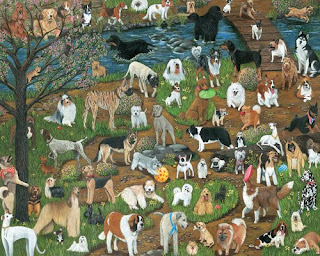
Last night's Westminster Dog show was amazing! I can’t believe the dog that won. Hickory, a 5-year-old Scottish deerhound, was named "Best in Show." I hadn’t even heard of a Scottish deerhound. I am familiar with several breeds including my very own Tibetan terror-Oops- I meant Tibetan terrier, Mario, but a Scottish deerhound? Nope-never heard of them. This got me thinking how and where did all the breeds come from?

Dogs, as many of you may already know, are said to come from wolves. It is believed that orphaned wolf pups taken at an early age could be tamed and socialized. These orphan pups were also, thought to have been nursed alongside human babies. Along with the tamed qualities, wild wolves that were the most social and least fearful (of humans) were bred together and overtime they would become more dog-like. It is also believed that dogs were used as beast of burdens, long before the horse and ox, and as a source of meat! WOW! Eat my dog? No way!

Over time the domestication of the wolves produced several physical changes including the reduction in overall size, smaller teeth and cranial cavities. The reduction in brain size affected the areas no longer needed by the domesticated wolves, such as alertness and the regurgitation of partially digested food to feed the pups.

As humans moved towards agricultural societies, desirable dog traits would also change. Now there are seven classifications used by the AKC. 1) The Sporting Group- bred to aid hunters by finding, flushing out and retrieving game. 2) Working Group-“bred to perform such jobs as guarding property, pulling sleds and performing water rescues.” 3) Toy Group- companion dogs. 4) Terrier Group- bred to hunt small animals. 5) Hound Group- bred to follow game by sight or smell. 6) Herding Group- bred to herd and control cattle and sheep. 7) Non-Sporting Group- breeds that don’t fit into these other groups. My Mario fits here.


Happy Puzzling!

Wednesday, February 9, 2011

Victory Garden


Hi Puzzlers,

The buzz here at the office has been all about getting ready for spring and picking out garden seeds. Well I don’t have a garden but I’ve been thinking about planting a small raised one, so I pulled out our Victory Garden puzzle and started looking at all the different seed packets to find inspiration. WOW! I really did find some inspiration.

I found out that the term Victory Garden was an actual term used to describe home gardens that were planted during both World Wars. These gardens were planted in backyards, empty lots, rooftops, and public parks and on community land. All this was done in the name of patriotism.

As a part of the war effort Allies across the world had put rations on foods like sugar, eggs, coffee, milk, cheese, meat and canned goods. Citizens were urged to produce their own “war garden” in an effort to reduce the pressure on the public food supply. First Lady Eleanor Roosevelt even planted a “food garden for defense” on the White House lawn. Nearly 20 million Victory Gardens were planted yielding an estimated 9-10 million tons of fresh fruits and vegetables. This amount was equal to “all of the commercially produced fresh vegetables, so the program made a difference.”

Citizen were also encouraged to can their own fruits and vegetables so the commercially made items could be sent to the troops. In 1943, 315,000 pressure cookers were sold versus the 66,000 sold in 1942. Popular women’s magazines began including gardening and canning articles.

One of the oldest remaining Victory Gardens is the Fenway Victory Garden in the Back Bay Fens of Boston, Massachusetts. The gardens are located on 7 acres of the Fens. Presiding over the 500 plots, each 15 feet by 25 feet, is the famous Prudential building. “The gardens are named for Richard D. Parker, a member of the original garden organizing committee. Thanks to his efforts the gardens are now an official Boston Historic Landmark.”

In 2009 First Lady Michelle Obama planted a vegetable garden on the South Lawn of the White House. This is the first garden to be planted at the White House since Eleanor Roosevelt’s victory garden. The First Lady planted the garden to help “educate children about healthful, locally grown fruit and vegetables at a time when obesity and diabetes have become a national concern.”

Happy Puzzling!

Wednesday, February 2, 2011

Hen Pecked


Hi Puzzlers,

Check out our newest puzzle Hen Pecked by artist Rollie Brandt. I just love it! It reminds me of my trips to Cape Cod. “Cape Cod and chickens?” I know, it sounds strange, but when we go to the Cape the first thing we do is go to my sister-in-law’s and pick up a dozen of what we call rainbow eggs. Sheri raises the chickens in her back yard, with the help of the family dogs, Ruby and Riley. These eggs are delicious and the different colors are just fun. Once we have the eggs picked everyone claims his or her eggs by color. I like the green ones; it’s like the Dr. Seuss book Green Eggs and Ham. Yes, its fun not to have to completely grow-up!

Sheri says the eggs are different colors due to the breed of the hen. She likes the rainbow effect and therefore raises several different types of hens. She also claims that free-range eggs taste better than any egg you’ll buy at the store. And I would have to agree. It did take me a while to get past the strange new colors of the shell. Growing up I had only seen white or brown eggs in the grocery stores. Also, the egg itself looked different. The yolk was a deep golden color and the white was not even a little runny. But, oh my yummy-ness they taste GREAT!!!

“The chicken (Gallus gallus domesticus) is a domesticated fowl, a subspecies of the Red Jungle fowl. As one of the most common and widespread domestic animals, and with a population of more than 24 billion in 2003, there are more chickens in the world than any other species of bird. Humans keep chickens primarily as a source of food, consuming both their meat and their eggs.” Recent evidence indicates chickens have been domesticated for over 10,000 years.

Chickens are omnivores and may live for five to ten years depending on the breed. Hens of special laying breeds can produce as many as 300 eggs per year. The world’s oldest chicken died at 16 of heart failure. Domestic chickens aren’t able to fly long distances, though; they can fly short distances to explore their surroundings or to roost on a tree or fence.

Chickens live happily in flocks. They establish pecking orders as new hens are added or as roosters are removed. This disruption can lead to violence and injury but once the order is established the flock returns to a harmonious state. The more dominant hens will have priority on food and nesting areas. Hens like to lay eggs in nests that already have eggs in them. Some hens have been known to move eggs from another hens’ nest to their own. An old trick used by farmers is to put fake eggs or golf balls in a nest to encourage the hen to lay eggs in a particular nest.

Now on to the Easter Bunny’s best kept secret. The Araucana and Ameraucana, also known as “Easter Egg Chickens”, are the two breeds of chickens that are known for laying colored eggs. Sorry Sheri, AKA Bunny, your secret is out!


Happy Puzzling!

Wednesday, January 26, 2011

Kites


Hi Puzzlers,

Just the other day I was driving by the park and notice a couple of kids flying kites. The brightly colored kites against the blue sky and the children bundled up like little snow-babies running through the snow was a beautiful site. I have seen children flying kites many times in the summer months but never in the winter.

Historians estimate that kites have been flying in our sky for at least 2000 years and many believe kites originated in China and the South Seas. “One legend suggests the first kite was made when a Chinese farmer tied a string to his hat to keep it from blowing away in a strong wind.” Kite flying was most likely invented for fun, but has had many uses thoughtout the years.

Militaries throughout the globe have used kites for target practice, and as bombs by attaching explosives to the kite and sending it over enemy lines, or by igniting it and crashing it into an enemy ship. Kites were used as a form of airmail between Maryland and Virginia during the American Civil War and during WWI kites were used for enemy observation and signaling. Kites in “WW II were provided with life rafts and intended for use in raising emergency antennas when sailors needed to abandon their ships.”

The scientific community has used kites for wind and weather research and to raise meteorological instruments and cameras into the skies. Most famous is Ben Franklin's use of a kite to prove that lightning was an electric phenomenon.

Kites were also used for measuring distances when it was difficult or dangerous to physically walk to another location. A rope would be attached to the kite and it was then flown over to the other side. This technique was used in the building of the bridge across Niagara Falls (New York to Canada) and to carry telephone wires.

One of the most unusual uses of kite power came from George Pocock in 1822. George used a pair of kites to pull a carriage; this use saved him on taxes as road taxes at the time were based on the number of horses a carriage used. Some of his trips would record speeds between 20 and 100 miles per hour!

Today’s kite uses include kite sailing, kite surfing, kite skiing and kite buggying.

Happy Puzzling!